
The JICW is a practitioner-focused research resource and a researcher-focused opportunity to impact policy and real-world security and defence decision-making. The JICW is a canvas for both researchers and practitioners to explore new and emerging security problems. The journal aims to shine a light on new and emerging trends in conflict, security, and intelligence and brings to the fore issues that are under-researched. The JICW is contributing to new understandings of emerging norms and new and unconventional actors. It explores hybrid and 5th-gen warfare and informs current discourse on emerging threats. The purpose of the journal is to bridge distinct views on security issues and to address the current shift in global affairs, where the tension existing between the state and non-state actors is increasingly challenging state power and legitimacy. Lastly, the JICW examines the appearance of a change to the current international liberal economic order and collective security state of global affairs.
The JICW publishes peer-reviewed papers that significantly enhance contemporary knowledge through the development and application of theory, and/or through original research and analysis of a current security issue. We welcome high-quality research from around the world, and the JICW covers all areas of international security. The JICW is particularly concerned to make connections and build bridges, both between different disciplinary and theoretical perspectives and researchers and practitioners.
The JICW will also host occasional special issues and annual conference proceedings.
Editorial Team
Editor in Chief

Candyce Kelshall – University of Ottawa
Editors




Editorial Team












Journal Archive
Volume 1, Issue 1
The JICW is designed to present research, contextual thought pieces and briefing notes with the specific objective of ensuring that new research is shared widely within the practitioner community. It is a forum for researchers to communicate directly with decision makers and tactical operators on emerging threat patterns, extremism and violent non-state actors. Practitioner authors provide first hand knowledge from the field. It is specifically designed to straddle the research and practitioner spheres so that both communities can be in direct contact with emerging trends in national security and defence.
Volume 1, Issue 2:
“Defence, Intelligence, Extremism: Dealing with Contemporary Conflict”
The Journal of Intelligence, Conflict, and Warfare’s Volume 1, Issue 2 entitled “Defence, Intelligence, Extremism: Dealing with Contemporary Conflict,” sought to place a primacy on pieces addressing the nexus of contemporary conflict, as well as addressing how defence and intelligence can lend significance to the radical changes occurring in warfare and conflict. This issue, further, seeks to explore how compound warfare is occurring in social conflict, with an emphasis placed on extremism and political violence.
Volume 1, Issue 3:
“Special Issue: 2018 CASIS Extremism Conference Proceedings”
The Journal of Intelligence, Conflict, and Warfare’s Volume 1, Issue 3, Special Issue, contains the purpose of publishing briefings and papers generated from information presented during CASIS Vancouver’s first annual Conference, held this past November. The conference sought to place a primacy on interrogating the nexus of contemporary conflict, as well as addressing how defence and intelligence can lend significance to the radical changes occurring in warfare and conflict. In response, the rationale behind this special issue of the JICW is the evolving nature of conflict and warfare.
Volume 2, Issue 1:
“The Influence of Non-State Actors on State Legitimacy”
The Journal of Intelligence, Conflict, and Warfare Volume 2, Issue 1 entitled “The Influence of Non-State Actors on State legitimacy” zeros in on the contemporary threats, as well, influential factors impacting centralized state government’s authority and ultimately, state legitimacy. Multifaceted, non-state-based networks contain a new transitional power, due to the democratization of information, which could be seen to challenge the legitimacy of states and their institutions.
Volume 2, Issue 2
“Violent Transnational Social Movements”
The inspiration behind the topic of Violent Transnational Social Movements (VTSMs) is based on the increasingly high number of groups using hybrid warfare to further their goals, whether that be political or economic. Edelmen (2001) further complexes this issue by commenting on how social movements create internal contention. With a limited understanding of how these groups work, the Journal is seeking to expand the field of knowledge through this publication, with a particular interest in the role that identity and social conflict play in the rise of VTSMs around the world.
Volume 2, Issue 3
“2019 CASIS Public Safety Conference Proceedings”
The second annual CASIS West Coast Security Conference brought together international tactical, academic, practitioner, intelligence, and defence perspectives on engaging with and addressing violent transnational social movements. Building upon our second edition, Volume 2, Issue 3 takes these different perspectives and presents them in a clear, and coherent manner. The following pieces are a reflection of presentations and discussion panels that took place during our two-day conference. The conference is unique because it generates both academic research and policy-relevant knowledge. This edition may be used to inform responses to emerging national and international security threats of a non-traditional and often ambiguous nature.
Volume 3, Issue 1:
“Non-Kinetic Threats & Disinformation: Fracturing Democracy”
The inspiration behind the topic originates from the observation that contemporary warfare is no longer using tanks and people. Rather, attacks are now seen through massive propaganda agendas spreading mass amounts of misinformation. The Canadian Centre for Contemporary Research (C4R) states that fake news “utilizes confirmation bias (the tendency to interpret new information of ones existing beliefs) through disseminating meticulously crafted messages to targeted audiences who are based on their online activities” (2019, p. 1). Since the subjects in focus in this journal are not always legislated comprehensively, the journal sought out to focus submissions where laws failed and succeeded in addressing non-kinetic threats, disinformation, and cyberspace.
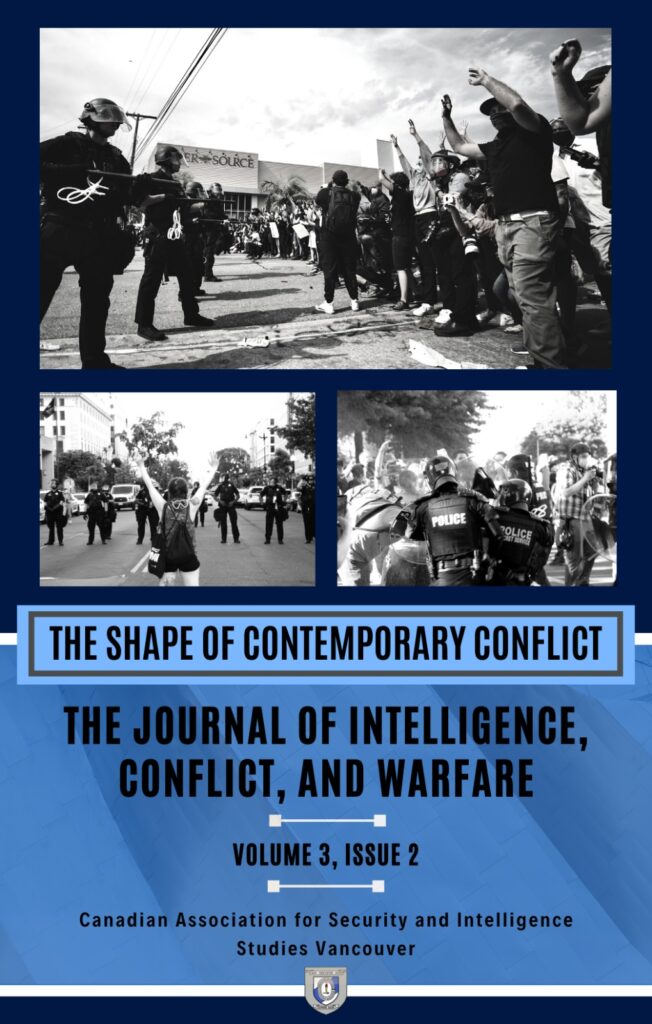
Volume 3, Issue 2:
“The Shape of Contemporary Conflict”
As aspects of conflict and warfare evolve, the JICW has intended to expand discourse and knowledge around the shape of contemporary conflict. As the social environment continues to adapt to emerging technology, the contemporary conflict has arguably been influenced by new norms and values that come with an advancing society; this publication will therefore have a focus on 5G warfare, extremism, policing strategies, and social movements in order to expand the conversation and understanding of the variable currently affecting conflict and security threats today. A goal of the JICW is to publish research and informed opinions on security issues so that decision-makers, practitioners, and academics may come to a better understanding of new emerging trends, threats, and patterns both domestically, and internationally. This publication hopes to bring together security, intelligence, and policy perspectives in various disciplines from around the world.
Volume 3, Issue 3:
“2020 West Coast Security Conference Proceedings on Contemporary Conflict”
The technology’s role in spreading extremism and the development of cyber capabilities by non-state actors present new challenges to policing and defence in the 21st century. The third annual CASIS West Coast Security Conference presented an opportunity for academics and practitioners to share information regarding extremist movements, the role of data analytics, cyber aggression, and the impact of artificial intelligence in shaping the future of defence strategy. The following pieces are a reflection of presentations and discussion panels that took place during our five-day conference. This edition may be used to inform responses to emerging national and international security threats of a non-traditional and often ambiguous nature.
Volume 4, Issue 1:
“21st Century Security Threats: Jurisdictional Challenges”
Guest Editor: Dr. Erin Gibbs Van Brunschot
The security threats that will shape events in the years after COVID-19—threats such as terrorism, cybersecurity, radicalization, espionage, and climate change—go beyond the boundaries of traditional states. The key threat actors are violent transnational social movements (VTSMs), criminal organizations, and other groups that operate outside the normal constraints of state sovereignty. The impact of 21st-century security threats is felt by groups of states and across entire regions. It is not surprising that international organizations play an increasing role in responding to global security threats.
Volume 4, Issue 2:
“Critical Explorations of New Security Threats”
The articles and briefings included in this new issue of the Journal of Intelligence, Conflict, and Warfare explore several areas of the current global environment such as security threats emerging from the formation of specific groups and their ideologies, strategic threats over the horizon, threats sprouting or reinforced by social media and technology, and the potential of strategic warning intelligence as a tool for Canada’s security intelligence agencies.
Volume 4, Issue 3:
“2021 West Coast Security Conference Proceedings on Critical Security”
As critical security issues continue to evolve and emerge, the annual CASIS West Coast Security Conference continues to bring to light unique academic research and generate policy-relevant knowledge. The 2021 West Coast Security Conference sought to provide an opportunity for practitioners and academics to share their perspectives and research not only on violent extremism, intelligence, and policing but also on Arctic security and leadership in the defence and security sphere.
Volume 5, Issue 1:
The articles and briefings in this issue of the Journal of Intelligence, Conflict, and Warfare can be categorized into two major topics: the potential benefits that technology can offer and the social and security concerns that we continue to experience. The following pieces explore topics such as the possibilities that deep learning tools can offer for conventional disarmament; the benefits and limitations of artificial intelligence in relation to strategy; and the potential of big data mapping to counter memetic violence. Other pieces take a deeper look at some of the gaps that surround the incel ideology; the connections between different far-right movements in Canada; the increasing security concerns in the Canadian Arctic; the Russia-Ukraine war; and the need for understanding cultural differences between different intelligence services.
Volume 5, Issue 2:
“Cyber Resilience & Security in the Age of the Metaverse”
As we move into uncharted territory with the emergence of the metaverse, despite its potential benefits, we are faced with uncertainty and greater potential risks, mainly due to the undetermined oversight and regulations that will apply to the metaverse. Although the metaverse is in its early stages and some might claim it will provide greater accessibility and solutions to many problems, its implications for national security and the risks posed to vulnerable people are still unclear. These are some topics that the theme articles included in this edition of the Journal of Intelligence, Conflict, and Warfare explore.
Volume 5, Issue 3:
“2022 West Coast Security Conference Proceedings on Disruption”
As critical security issues continue to evolve and emerge, the annual CASIS West Coast Security Conference continues to bring to light unique academic research and generate policy-relevant knowledge. The 2022 West Coast Security Conference sought to provide an opportunity for practitioners and academics to share their perspectives and research not only on violent extremism, intelligence, and policing but also on online and offline resilience and leadership in the defence and security sphere. The pieces included in this edition of the Journal of Intelligence, Conflict, and Warfare are a reflection of presentations and discussions that took place during the five-day 2022 CASIS Conference.