
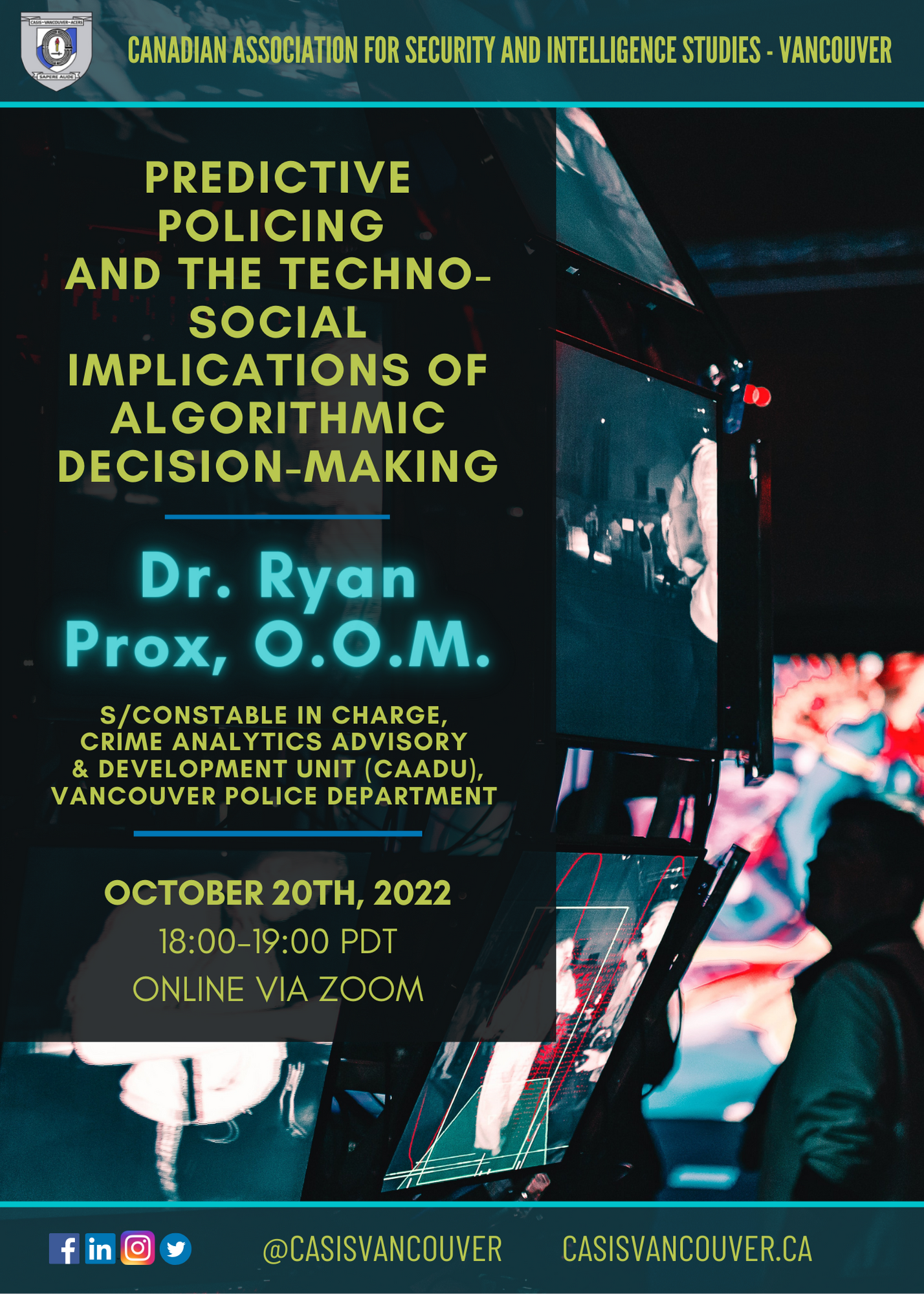
THURSDAY, October 20, 2022, 18:00-19:00 PST | VIRTUAL EVENT | MEMBERS: FREE / NON-MEMBERS: $11
Speaker Bio:
Dr. Ryan Prox is a Faculty Member and Adjunct Professor at Simon Fraser University where he instructs on police studies and intelligence tradecraft, with a research focus on AI and algorithmic decision-making technology.
Dr. Prox is the S/Constable in Charge of the Crime Analytics Advisory and Development Unit that pioneers and implements analytic programs and technology for the Vancouver Police Department (VPD). He has also pioneered artificial intelligence systems by implementing the first in Canada crime forecasting system in a police department.
Dr. Prox has provided advisory expertise to major metropolitan police services to help adopt intelligence-led policing practices and training to law enforcement around the world. Dr. Prox has also served as a Special Advisor to the International Criminal Court (ICC); holds the position of Senior Expert to the European Union (EU) Support Against Organized Crime, with multiple overseas postings; is a member of the European Commission, Advisory Committee on the Next Generation Community Policing Project; and serves as a Legal Advisor with the United Nations Office for Project Services (UNOPS).
Dr. Prox has written extensively on the transformational change required in police services to empower evidence-based decision-making, as well as on the highly controversial subject of ethics, data bias, and techno-social implications of algorithmic policing, as it relates to regulatory frameworks such as the European Union’s (EU) General Data Protection Regulation (GDPR). His most recent textbook, Crime & Intelligence Analysis in Canada, has extensive coverage on the legislative and ethical implications of algorithmic decision-making technology in law enforcement.

Relevant Readings:
Schwartz, D. M., Williams, I., Condon, C., & Prox, R. (2021). Crime and intelligence analysis in Canada: An introduction. Emond Publishing.
Esri Canada. (2021, June 15). Modernizing COMPSTAT at the Vancouver Police Department with ArcGIS and Microsoft Power BI (R. Prox, Guest author). https://resources.esri.ca/case-studies-2/modernizing-compstat-at-the-vancouver-police-department-with-esri-s-arcgis-platform-and-microsoft-power-bi
Prox, R. (2020, March). Lessons learned on implementing big data machine learning: The case of predictive policing at the Vancouver Police Department. Police Chief, 87(3), 46-51. https://www.policechiefmagazine.org/lessons-learned-on-implementing-big-data-machine-learning/
Prox, R. (2020). Utility of predictive policing: Evaluating a spatial-temporal forecasting model in an operational deployment [Doctoral Thesis]. Charles Sturt University. https://researchoutput.csu.edu.au/en/publications/utility-of-predictive-policing-evaluating-a-spatial-temporal-fore
Sargsyan, G., & Prox, R. (2019). Augmenting crime predictions with engagement: Synergy of predictive policing and community policing paradigms. In G. Leventakis & M. Haberfeld (Eds.), Synergy of community policing and technology (pp. 31-40). SpringerBriefs in Criminology. https://doi.org/10.1007/978-3-030-00299-2_3